
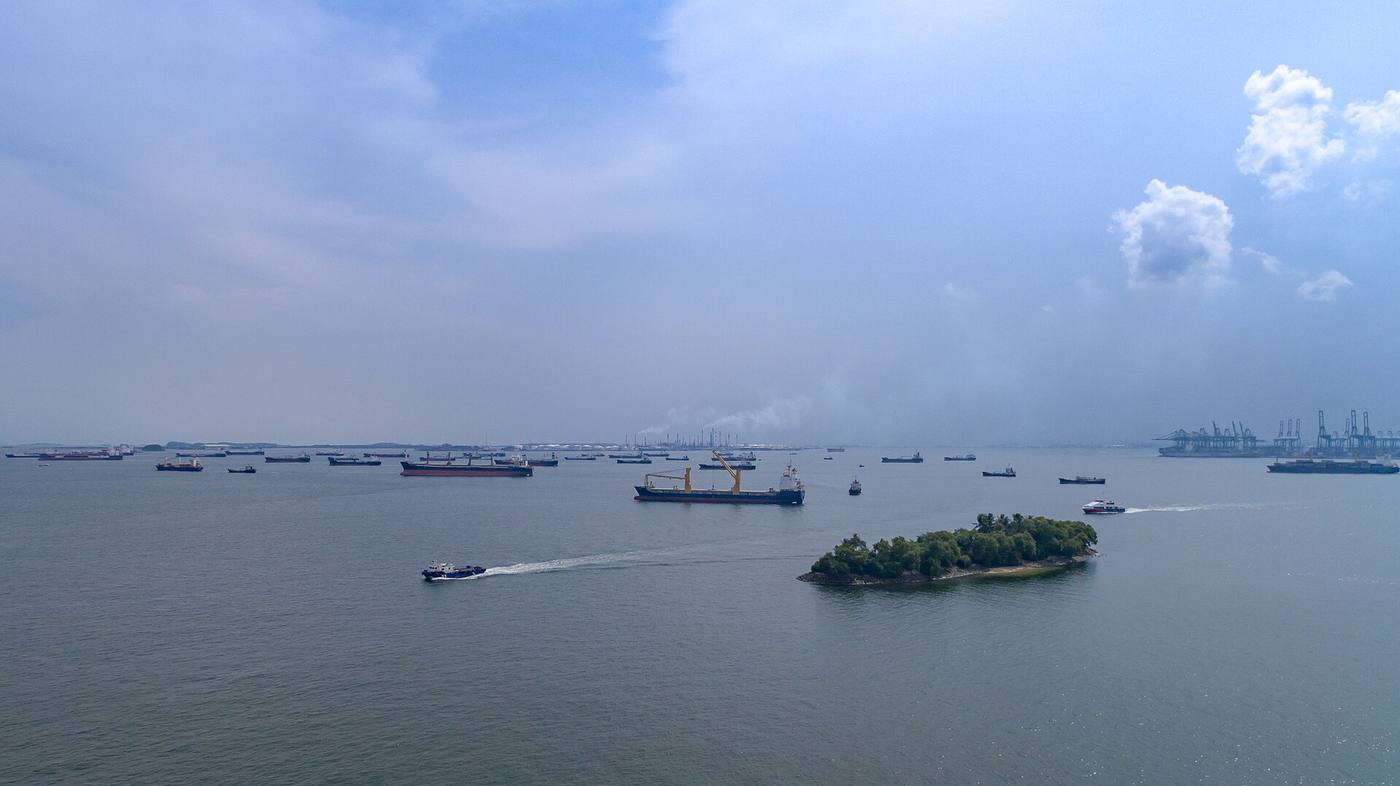
Most collision-avoidance AI treats other ships as weather — moving hazards to be avoided, not minds to be reasoned with. That works while the other ships are dumb. The moment several vessels run their own avoidance policies, the problem changes character: each agent's action changes every other agent's situation, which changes their action — a coupled system, not a sequence of decisions. Maritime-GPT analysis
Multi-agent reinforcement learning is the field's answer: train ships togetherso they learn avoidance policies that account for each other. It's the difference between a ship that reacts and a fleet that cooperates — and between the easy version of the problem and the real one. Maritime-GPT analysis
Key findings
- Cooperative multi-agent RL produces coordinated avoidance in simulation — agents learn to reason about neighbours' likely motions, not just their positions. Research demonstration
- Dense-traffic performance is the real discriminator — the best work reports far smaller degradation in high-density scenarios than single-agent baselines. Research demonstration
- Emergent behaviour is the open problem — policies trained together develop coordination conventions no one specified, which can be correct or catastrophically wrong. Maritime-GPT analysis
- All published work trains and tests in the same simulated population — real mixed traffic (AI ships + human ships + non-compliant ships) is unstudied. Established
- Coordination without communication — ships inferring intent from motion, as human navigators do — is emerging but early. Experimental
Why multi-ship is a different problem
Single-agent avoidance assumes a fixed environment: you move, they don't reason back. In multi-ship traffic every agent's optimal action depends on what the others do, which depends on what you do — a game, not a planning problem. The foundational MADRL work (2021) established the framing: each ship an independent learner, avoiding while being avoided. Research demonstration
The 2025 cooperative-PPO work adds the piece that makes it maritime: encounter-situation awareness and COLREGS-shaped rewards, so cooperating agents don't just avoid each other — they avoid each other the way the rules expect. Two AI ships meeting head-on should both alter to starboard; a policy that invents its own convention is a liability, not a feature. Research demonstration
The emergent-convention problem
Train agents together long enough and they develop coordination the designers didn't write in — implicit conventions, learned from co-adaptation, that emerge because they worked in training. Sometimes that's seamanship rediscovered; sometimes it's a bug with a good success rate. Maritime-GPT analysis
The danger is asymmetric: a convention that works against the training population may fail against anything else — a human-driven ship, a different vendor's policy, a fishing boat that ignores the rules entirely. An agent that learned "other ships always give way in situation X" is dangerous the moment it meets a ship that doesn't. COLREGS exists precisely to prevent private conventions; encoding it into shared rewards is the field's way of making the emergent behaviour stay inside the rules. Maritime-GPT analysis
Maritime-GPT synthesis of the cooperative MADRL pattern. Maritime-GPT analysis
What we know / don't / being tested
What we know
- Co-trained agents coordinate in simulation and degrade more gracefully in dense traffic.
- COLREGS-shaped rewards steer emergent behaviour toward rule-consistent conventions.
- Multi-ship is the correct frame — single-ship assumptions don't scale to real traffic.
What we don't know
- Mixed traffic — AI ships among human and non-compliant vessels, the real case.
- Cross-vendor compatibility — two different policies meeting have never been studied.
- Failure correlation — whether agents trained alike fail alike, creating common-mode risk.
Being tested
- Cooperative PPO with encounter awareness and rule-shaped rewards.
- Intent inference — reading a target's likely manoeuvre from its motion.
- Scalable training — holding performance as the number of agents grows.
Maritime-GPT analysis
The hardest problem isn't coordination — it's compatibility. Two AI ships from different developers, trained on different simulators, meeting in the Dover Strait: nothing in the literature covers that, and it's the scenario that will actually happen. Standards for avoidance-policy behaviour — a machine-readable equivalent of COLREGS that different systems can rely on each other to follow — are the missing piece the MASS framework will eventually have to address. Maritime-GPT analysis
Open research problems
- Heterogeneous-population training — agents robust to unfamiliar policies, not just their training cohort.
- Common-mode failure analysis — do similar architectures share blind spots.
- Intent communication — whether ships should broadcast manoeuvre intent, and to what standard.
- Real-traffic validation — replaying learned policies against recorded multi-vessel encounters.
Evidence scorecard
| Dimension | Rating | Basis |
|---|---|---|
| Evidence strength | Moderate | Multiple simulation studies; mixed-traffic and real cases absent. |
| Research maturity | Experimental | Co-training demonstrated; deployment far off. |
| Maritime deployment | None verified | No published operational multi-agent system. |
| Confidence in conclusions | High | Findings per-paper; emergent-behaviour analysis labelled. |
Related tools & reading
Sources
- COLREGs-compliant multi-ship collision avoidance via cooperative PPO — Frontiers in Marine Science (2025)Peer-reviewed
Cooperative training where multiple ship agents learn avoidance while accounting for neighbours' motions — the multi-agent pattern made COLREGS-aware. - A novel ship collision avoidance awareness approach for cooperating ships using multi-agent deep RL — J. Marine Science and Engineering 9(10):1056 (2021)Peer-reviewed (foundational)
Early MADRL treatment of each ship as an independent learning agent — the canonical starting point for the multi-agent framing. - Deep RL model for multi-ship collision avoidance decision making — Scientific Reports (2025), s41598-025-05636-3Peer-reviewed
Dense-traffic focus — reports smaller performance degradation in high-density scenarios than prior baselines.
Results are the cited papers' simulation findings; accessed 5 October 2026. Editorial analysis only.