
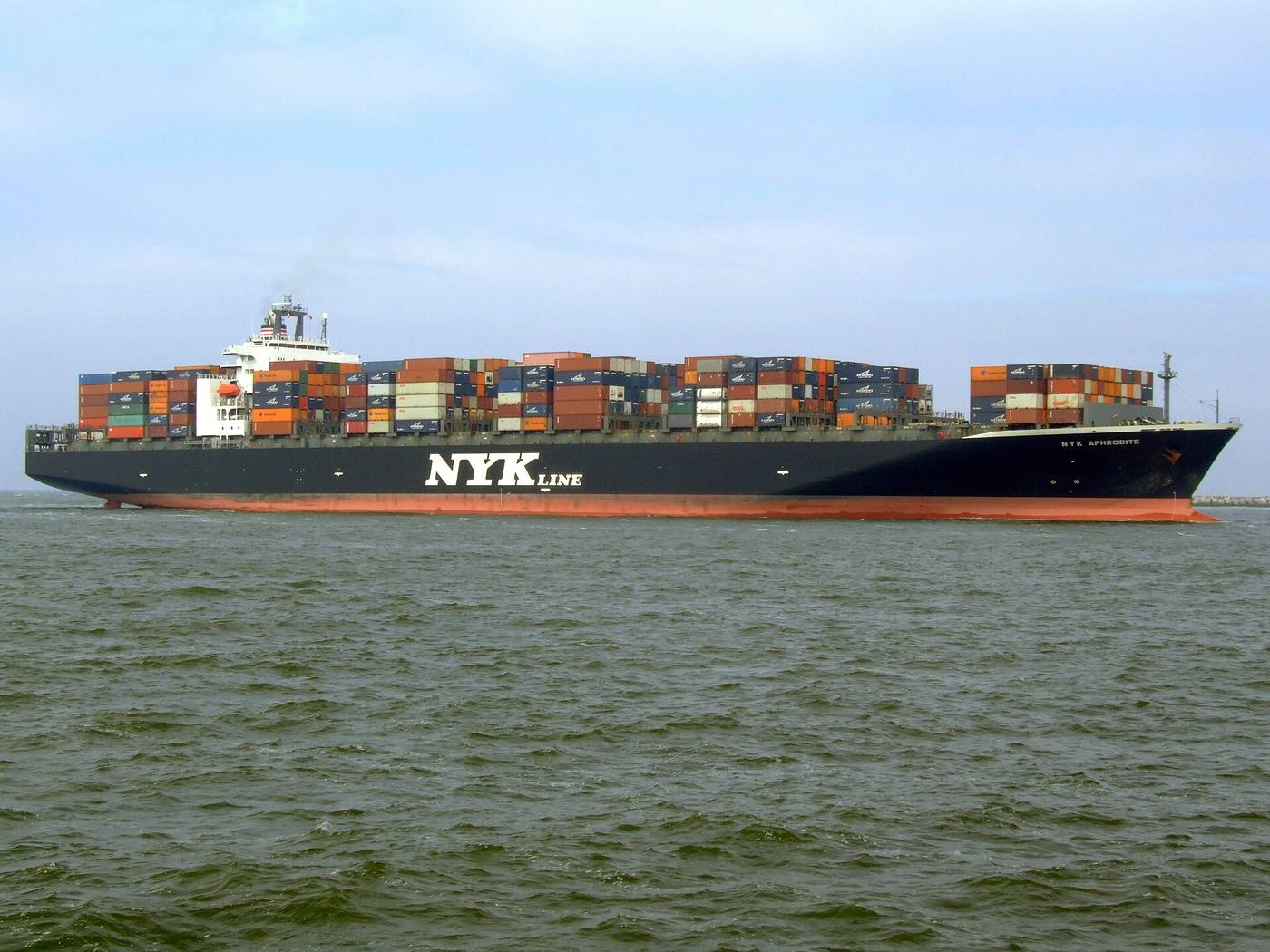
Every AIS transmission is a vote for where a ship goes — and accumulated over years and billions of positions, those votes draw the ocean's real road map. Not the charted routes, but the sailed ones: the lanes traffic actually follows, season by season, vessel type by vessel type.
A model trained on that history learns the normal — and therefore can do two things a chart can't: predict where a ship is probably going, and flag the ship that isn't going where a ship like it should be going.
Key findings
- AIS history is the largest behavioural dataset of shipping — the foundation for learned route prediction. Established
- The model's output is probabilistic — a distribution over likely destinations and routes, not a single prediction. Established
- Prediction powers two applications: anticipatory analytics (ETA, traffic forecasting) and anomaly detection (the vessel off-pattern). Established
- AIS data is corrupted by spoofing, gaps, and errors — the model learns the noise as well as the signal. Established
- The hard evaluation is the unusual case — the model is best on the common routes, worst where the data is thin. Maritime-GPT analysis
What the data actually teaches
An AIS-trained model learns the statistical geography of shipping — which lanes vessels prefer by type and season, how they approach ports, where they anchor, how they route around weather. The prediction isn't 'this ship will go to Singapore' — it's a probability distribution over destinations and routes conditioned on the track so far. The model's competence is the traffic pattern's competence: strong where shipping is regular, thin where it's rare. Established
Two uses, one model
- <strong>Anticipation.</strong> Predicting ETAs, traffic density, port congestion — the forward view that powers scheduling. Established
- <strong>Anomaly.</strong> Flagging the vessel whose track doesn't match the pattern its type should follow — the dark-fleet, smuggling, or distress signature. Established
- <strong>Context.</strong> Feeding the route-probability estimate into other systems — the collision model, the port twin, the surveillance stack. Maritime-GPT analysis
The data-quality floor
AIS is a self-reported system — positions can be wrong, fields corrupted, and entire tracks falsified by spoofing or silent switching. A model trained on the raw stream learns the noise as well as the signal, and the anomaly detection it produces inherits the same confusion: a 'suspicious' track may be a transmitter fault, not a dark fleet. The honest model treats data-quality filtering as a preprocessing layer, not an assumption. Established
The evaluation honesty
Route prediction papers report accuracy averaged over all tracks — which mostly measures performance on the common routes the model already knows. The cases that matter (the unusual voyage, the diverted ship, the vessel off-pattern) are precisely where the data is thin and the accuracy is worst. The honest benchmark is per-case: how well does it predict the route that isn't the modal one? A model that's 95% right on the average ship may be useless on the ship that's actually interesting. Maritime-GPT analysis
What we know
- AIS history is the foundation dataset for learned route prediction.
- The output is a probability distribution over destinations/routes, not a point estimate.
- Data quality — spoofing, gaps, errors — is a preprocessing problem, not an edge case.
What we don't
- How well prediction holds on rare routes where data is sparse.
- Whether anomaly detection based on AIS can distinguish spoofing from malfunction.
- The model's behaviour under deliberate AIS manipulation.
Being tested
- Per-case accuracy benchmarks on unusual voyages.
- Spoofing-robust anomaly scoring.
- Route-prediction integration into traffic-forecast systems.
Maritime-GPT analysis
AIS-trained prediction is maritime AI's most honest dataset problem — the data is real, the patterns are real, and so is the noise. The model learns where ships go and can spot the one that doesn't belong — but only where the data is thick. The confidence interval matters more than the point estimate: the model that admits which routes it doesn't know is the one worth trusting on the ones it does. Maritime-GPT analysis
This is a research feature, not operational guidance. Simulation results are reported as simulation; demonstrations are not deployments; company claims are attributed as such. Verify safety-critical decisions against official nautical publications and flag-state requirements.
Sources & evidence
The satellite stack that uses AIS-anomaly as its signal.
The data-corruption problem the prediction model inherits.