
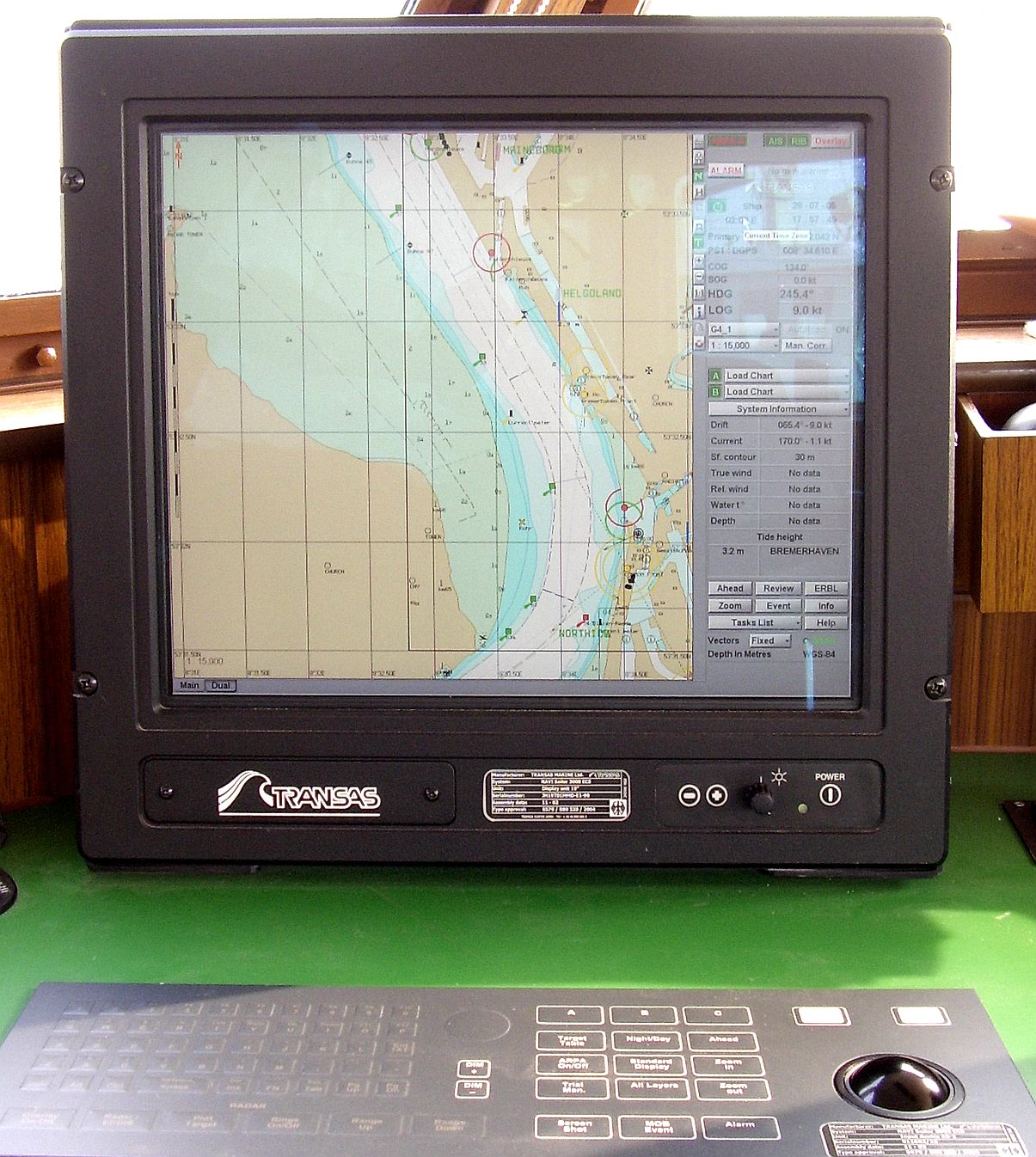
Ask a raw LLM to navigate a ship and it will produce a beautifully written, confident, frequently wrong answer. Ask it to call a CPA calculator, look up a rule, and hand the answer to a constrained subsystem that actually decides the manoeuvre — and you get something different. That difference is what the 2025–26 "LLM navigation agent" literature is really about. Maritime-GPT analysis
Key findings
- Navigation-GPT is a framework, not a model — a large reasoning core plus a small constrained core plus a dynamics layer. The model is interchangeable; the architecture is the contribution. Research demonstration
- Its training recipe pairs LoRA fine-tuning with rule-controlled RL (RC-GRPO) to push behaviour toward COLREGS-consistent outputs — the first serious attempt to bind language reasoning to a formal rule set. Research demonstration
- Reported: 86% avoidance success, 90% compliance, 11.13 s latency — strong for the class, and the same three numbers are also its limitations (see our companion piece). Research demonstration
- An independent convergent design (Nav-DLLC) reports a similar dual-core pattern — evidence the architecture shape, not one lab's tuning, is what works. Research demonstration
- Separating procedural reflexes (fine-tuning) from declarative knowledge (RAG) emerges as a recurring design law — retrieval can actively hurt logic-heavy tasks. Research demonstration
The anatomy of the design
Navigation-GPT splits cognition across two cooperating language-model cores rather than asking one model to do everything: Research demonstration
- The reasoning core — a large LLM running ReAct (reason + act). It reads the encounter, decomposes the task, and calls tools: position and CPA computation, rule retrieval, environmental queries. It decides what needs deciding and gathers the facts to decide it.
- The action core — a smaller model, fine-tuned with LoRA on maritime instruction data and then constrained by RC-GRPO, an RL method in which the reward encodes COLREGS compliance. It turns the reasoning core's intent into a manoeuvre that the rules permit.
- The dynamics layer — a motion model converts the chosen manoeuvre into a feasible trajectory; a PID controller tracks it. The language models never touch the rudder directly.
Maritime-GPT synthesis of the published framework (IET ITS 2025; Nav-DLLC). Simplified — the papers contain additional state and memory structure. Maritime-GPT analysis
Why dual-core — the design law hiding in plain sight
The instinct is to ask: why not one big model with all the tools? Two findings answer it. Maritime-GPT analysis
First, the roles fight each other. Open-ended reasoning wants breadth and creativity; rule-constrained action wants a narrow, verified output space. A single model oscillates between the two failure modes — under-thinking the encounter or over-creative in the manoeuvre. Splitting them lets each be optimised against its own objective: the reasoning core is judged on decomposition quality, the action core on rule-compliance reward. Research demonstration
Second, the MARTIAN study (2026) gives the separation empirical teeth: on a mid-size edge-deployed agent, retrieval-augmented generation lifted total accuracy from 73.2% to 81.2% — but degraded pure-logic COLREG manoeuvring accuracy (78.5% → 77.4%). Retrieval adds knowledge and adds noise; procedural reasoning works best unretrieved. The authors draw exactly the architectural conclusion Navigation-GPT embodies: decouple procedural reflexes (bake them in) from declarative knowledge (fetch it on demand). Research demonstration
Where it actually stands
What we know
- The dual-core + tool-use pattern is reproducible — an independent team reached a convergent design.
- Rule-controlled RL meaningfully steers language output toward compliance.
- Latency (~11 s) is viable for open-sea reasoning, not for close-quarters reflexes — hence the layered split.
What we don't know
- Whether the separation survives messier inputs — real radar noise, conflicting AIS, three-plus vessel encounters.
- Whether the dynamics/PID layer masks language-layer errors in the published metrics.
- How the framework is verified for survey — two stochastic components compound assurance complexity.
Being tested
- Edge-size variants — mid-size agents on Jetson-class hardware prove the pattern isn't cloud-bound.
- Multi-agent settings — ships running these agents reasoning about each other is the open frontier.
- LLM-as-interface vs LLM-as-decider — where the language layer's authority ends is an active design debate.
Maritime-GPT analysis
Read the papers for the pattern, not the product. What will survive from this research wave isn't any specific model — it's the decomposition: an unconstrained reasoner that gathers and interprets, a constrained decider bound by rules, and a deterministic physics layer that keeps everything inside the ship's actual capabilities. That triple-layer shape is appearing independently across collision avoidance, digital twins and maintenance agents — which is the strongest signal it's correct. Maritime-GPT analysis
The caution: every component after the reasoning core is where safety actually lives. The published metrics credit the whole system, but the LLM's contribution is bounded by the tools and constraints around it — a useful reminder that "AI navigates a ship" is almost always shorthand for "a carefully engineered system does, with an AI inside." Maritime-GPT analysis
Open research problems
- Compositional verification — how to assure a system whose behaviour emerges from two interacting stochastic components.
- Ablation honesty — isolating the LLM's contribution from the safety scaffolding's in published metrics.
- Cross-ship interaction — two of these agents meeting head-on is unstudied at publication time.
- Degradation ladders — documented behaviour when tools fail or return contradictory data mid-reasoning.
Evidence scorecard
| Dimension | Rating | Basis |
|---|---|---|
| Evidence strength | Moderate | Multiple convergent peer-reviewed studies; all simulation. |
| Research maturity | Experimental | Working frameworks in scenario suites; no at-sea validation. |
| Architectural significance | High | Pattern replicated independently and echoed across adjacent domains. |
| Confidence in conclusions | High | Claims trace to named papers; analysis labelled. |
Related tools & reading
- Can an LLM be trusted with COLREGS decisions?
- Small language models for ships
- Edge AI at sea
- Maritime glossary
Sources
- Navigation-GPT: A Robust and Adaptive Framework Utilizing Large Language Models for Navigation Applications — Yang, Liu, Chen et al.Peer-reviewed (IET ITS, 2025)
The architecture under analysis: dual-core LLM, ReAct tool-calling, LoRA + RC-GRPO training, dynamics model + PID execution. Reports 86% avoidance success, 90% rule compliance, 11.13 s latency. - Dual large language model core-driven adaptive framework for ship navigation agents (Nav-DLLC) — Chinese Journal of Ship Research (SciOpen)Peer-reviewed
Independent convergent design — two cooperating LLM cores with comparable reported performance; useful for checking whether the pattern generalises. - Path planning and collision avoidance technologies for MASS: a review of COLREGs compliance, algorithmic trends and the Navigation-GPT framework — Journal of Navigation (Cambridge UP, 2025)Peer-reviewed review
Positions the framework inside the classical/reactive/learning taxonomy and documents where each family fails COLREGS compliance. - Deploying Efficient LLM Agents on MASS: Fine-Tuning, RAG, and Function Calling in a Mid-Size Model (MARTIAN) — Information (MDPI), 17(3):284Peer-reviewed (2026)
The edge-deployment counterpart: a 14B agent on Jetson-class hardware, 22.4 ms/token, and the empirical finding that RAG can degrade pure-logic COLREG reasoning.
All performance figures are the cited papers' reported simulation results. Accessed 5 October 2026. Editorial analysis, not navigation or safety advice.