
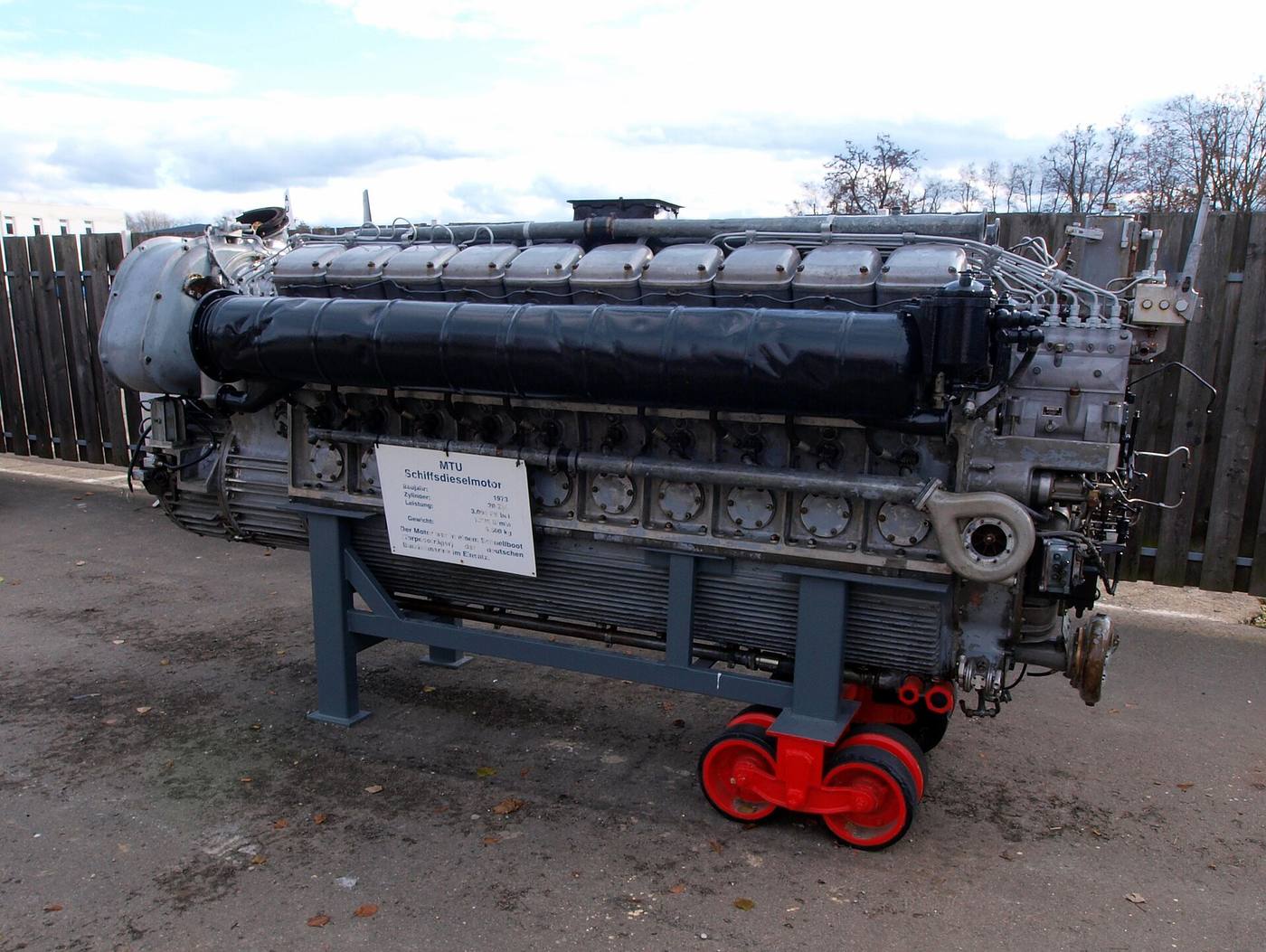
A marine diesel doesn't fail suddenly — it degrades. Exhaust temperatures drift, bearing vibration creeps, fuel-rail pressure wanders off baseline, and hours or days before the threshold alarm fires, the experienced engineer's ear catches something the instruments haven't flagged yet. The entire promise of AI predictive maintenance is automating that ear: a model that learns the plant's normal so well it notices the deviation long before a fixed limit does. Maritime-GPT analysis
In 2026 that stopped being a pitch. An Ocean Engineering study ran a Transformer autoencoder on 91 days of real offshore-vessel data — a hybrid diesel-electric ship with six gensets under dynamic positioning — and detected all four injected fault scenarios with prognostic lead times between 97 and 637 minutes. That's a real hull, real sensors, real early warning. Field trial
Key findings
- Unsupervised autoencoders are the method — they learn "normal" from unlabelled data, so they don't need the rare thing: examples of actual failures. Established
- Validated on a real vessel: 4/4 fault scenarios detected, 97–637 min early — meaningful lead time, not just detection. Field trial
- The output is moving from alarm to health index — continuous degradation scores (e.g., turbocharger HI) beat binary alerts for planning. Research demonstration
- The hardest part isn't detection, it's operating-condition false alarms — the model must distinguish "degrading" from "just loaded differently." Maritime-GPT analysis
- The LLM enters as the explainer — tool-calling agents that read the detector's output and write the diagnosis. Research demonstration
Why unsupervised is the only honest approach
Ships don't break often enough to train a classifier on real failures — you simply don't have thousands of labelled breakdowns. So the field does something smarter: train an autoencoder to reconstruct normal operation, then flag whatever it can't reconstruct. The reconstruction error is the anomaly signal — no failure labels needed. Established
The Transformer variant is what made it work on real machinery data: multivariate time-series (temps, pressures, loads, vibration) with long-range dependencies that an LSTM-era model missed. Add residual analysis — SPRT, squared-residual tests — and you get detection that survived contact with real-ship noise, not just clean simulator data. Research demonstration
The two failure modes that decide deployment
False alarms under operating-condition change. The model learns "normal at this load, this sea state, this fouling" — change any of those and an honest detector fires on benign drift. The 2026 turbocharger work attacks exactly this: maintenance-aware training that separates degradation from condition swings and online cleaning, so the health index tracks wear, not weather. Research demonstration False alarms aren't a tuning nuisance — they're what makes engineers tape over the alarm. Maritime-GPT analysis
The lead-time/reliability trade. Catch a fault 10 hours early and some alerts will be noise; catch it 10 minutes early and they're certain but useless. The published 97–637-minute window is the interesting middle — long enough to plan, short enough to trust — but it's from one vessel and four scenarios, not a fleet statistic. Maritime-GPT analysis
Where the language model fits — and where it doesn't
The detector's output is a number: deviation exceeded threshold on sensors 4, 7, 11. Turning that into "fuel injector on genset 3 showing early spray degradation, check at next opportunity" is interpretation — and that's what the LLM layer adds. The 2026 agentic design has the LLM call domain tools to pull measurements, compute derived metrics and query the anomaly outputs, then write the diagnosis. The LLM doesn't do the detecting; it does the explaining — the correct division of labour, again. Research demonstration
Maritime-GPT synthesis of the published pipeline. Maritime-GPT analysis
What we know / don't / being tested
What we know
- Unsupervised detection works on real machinery data with real lead time.
- Health-index tracking beats binary alarms for maintenance planning.
- Tool-mediated LLM explanation produces readable diagnoses.
What we don't know
- Fleet-scale false-alarm rates — one vessel's results don't generalise.
- Transfer across plants — a model trained on a diesel-electric OSV vs a two-stroke bulker.
- Integration into PMS/class survey regimes — how learned alerts fit planned-maintenance systems.
Being tested
- Health indices for specific machinery (turbochargers, gensets).
- Agentic explanation layers on detector outputs.
- Condition-invariant learning — separating wear from load/weather/fouling.
Maritime-GPT analysis
This is the AI application closest to paying for itself. Unlike collision avoidance, a false positive here costs an inspection, not a ship — the risk asymmetry is inverted, which is why predictive maintenance will reach the engineroom long before autonomy reaches the bridge. The adoption gate isn't accuracy, it's trust: the detector that cries wolf gets disconnected within a month. Condition-invariance is the feature to buy. Maritime-GPT analysis
Open research problems
- Fleet-scale validation — real false-alarm and missed-detection rates across many hulls and plants.
- Transfer learning — adapting a trained detector to a different engine without retraining from scratch.
- Remaining-useful-life prediction — moving from "something's wrong" to "fails in ~200 hours."
- Class/PMS integration — how a learned health index enters planned-maintenance and survey frameworks.
Evidence scorecard
| Dimension | Rating | Basis |
|---|---|---|
| Evidence strength | Moderate–high | Real-ship validation published; fleet-scale absent. |
| Research maturity | Field trial | Proven on a real vessel; not yet standard fit. |
| Maritime deployment | Limited | Vendor CBM systems exist; peer-reviewed fleet deployments thin. |
| Confidence in conclusions | High | Lead times and detections from the named real-ship study. |
Related tools & reading
Sources
- Agentic AI for autonomous condition monitoring and predictive maintenance of marine vessels — Ocean Engineering 364, art. 127078 (2026)Peer-reviewed — real-ship validation
91 days of offshore-vessel data: Transformer autoencoder detects all 4 fault scenarios, 97–637 min prognostic lead — the strongest published end-to-end result. - Anomaly detection in time-series data — Transformer autoencoder + SPRT/SSNR for marine diesel engines — Int. J. Prognostics & Health ManagementPeer-reviewed
Unsupervised anomaly detection needing no labelled failures — trains on 'normal', flags residual deviation; the method the field is converging on. - A maintenance-aware temporal contrastive autoencoder for health-index learning of marine turbochargers under real-ship operation — J. Marine Science and Engineering 14(10):873 (2026)Peer-reviewed — DOI 10.3390/jmse14100873
Learns a continuous health index for turbochargers on real-ship data, robust to operating-condition swings and cleaning cycles — degradation tracking, not just alarm.
Detection counts and lead times are the named study's results on its stated dataset; accessed 5 October 2026. Editorial analysis only.