
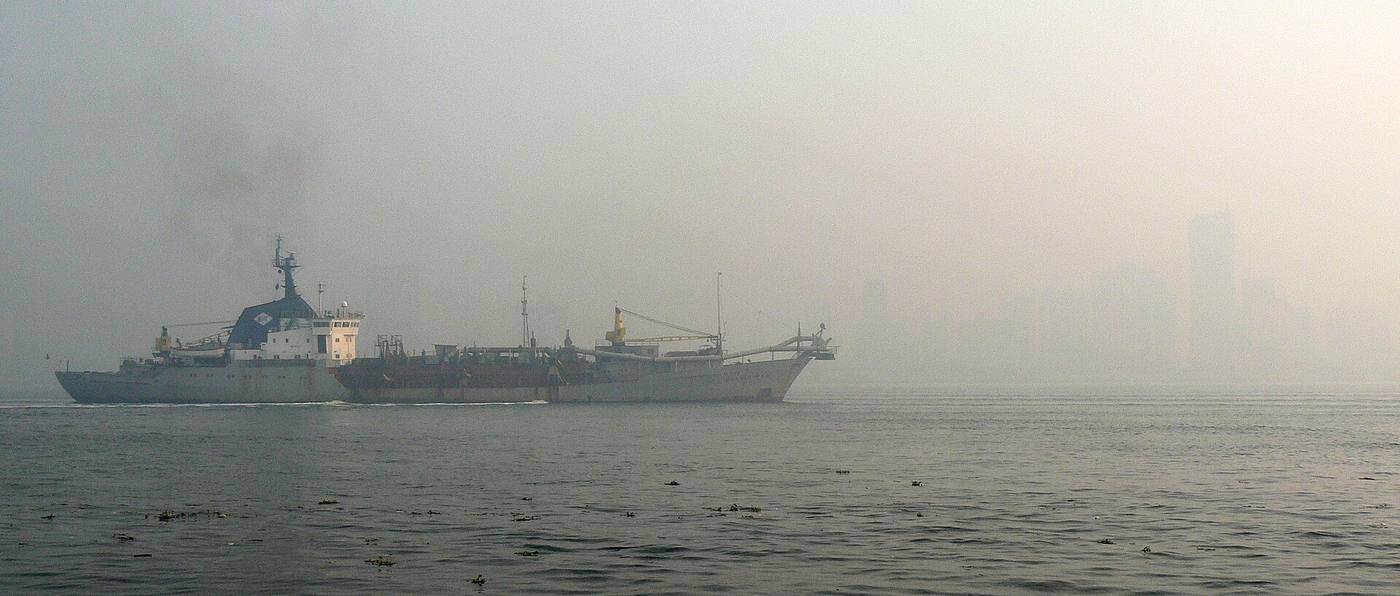
Restricted visibility is not a corner case — it is the regime in which COLREGS Rule 19 exists, the regime in which the rules' extra caution applies, and the regime in which the camera the autonomy stack leans on is least reliable. A lookout that quits in fog is not a lookout.
The maritime-vision literature on restricted visibility is smaller and more honest than the daylight literature — precisely because the failures are visible. This article assembles what is actually demonstrated: thermal-IR, image enhancement, sensor fusion — and what remains unsolved.
Key findings
- Visible-band camera performance in fog degrades roughly with human vision — a sensor that fails where the human fails cannot replace the lookout. Established
- Thermal and near-infrared cameras demonstrably extend detection into darkness and partial visibility — but sea clutter, sea-state noise and cost limit them to a complementary role. Research demonstration
- Image-dehazing / low-light enhancement restores some contrast but invents no new signal — it cannot recover targets the sensor never resolved. Research demonstration
- Radar remains the only modality that sees through fog, rain and darkness at navigational range — restricted-visibility fusion is the architecture the research converges on. Established
- No peer-reviewed work establishes a camera-only lookout satisfying Rule 19's special obligations in fog. Established
Why fog is a physics problem, not a data problem
A camera measures light that reached the lens. Fog scatters that light — the target is genuinely absent from the image, not merely hard to find in it. No training data fixes a photon that never arrived. This is why restricted-visibility vision work splits into two honest tracks: <em>recover what contrast remains</em> (dehazing, enhancement) and <em>capture what visible light misses</em> (thermal IR, radar fusion). Maritime-GPT analysis
What the research actually shows
- <strong>Thermal IR sees heat, not light.</strong> A ship's engine block and hull sun-load radiate through darkness and light fog — maritime IR datasets (Singapore Maritime Dataset's NIR set, MODD's IR sequences) demonstrate detection at ranges visible-band fails. But sea-state clutter and thermal cross-over (cold hull at dawn) are documented failure modes. Research demonstration
- <strong>Dehazing helps the human more than the model.</strong> Restored contrast improves a watchkeeper's picture and gives a downstream detector slightly better inputs — but enhancement hallucinates no object. Research demonstration
- <strong>Radar is the through-fog modality.</strong> Fog, rain and darkness are transparent to radar — the sensor every Rule 19 regime already depends on. Fusion research consistently finds camera contribution marginal in dense fog and dominant in clear traffic. Established
- <strong>Sensor dissonance is the safety signal.</strong> A radar contact with no visual confirmation in fog is the alarm state fusion is for — the camera's silence is information. Maritime-GPT analysis
| Modality | Through fog | Through darkness | Through rain | What it adds |
|---|---|---|---|---|
| Visible camera | Poor — scatters | Fails | Degraded | Class, aspect, lights, detail |
| Thermal IR | Partial — depends on contrast | Strong | Moderate | Heat signature, small craft |
| Radar | Strong | Strong | Strong (clutter) | Range, bearing, velocity |
| AIS | Unaffected | Unaffected | Unaffected | Identity — when honest |
The architecture the evidence supports
Restricted visibility is the regime that dissolves the 'camera vs human' framing. The camera isn't a better lookout — it's a different one: weak where the human is weak, cheap, tireless, and fused. The Rule 19-compliant stack is radar-primary, AIS-assisted, thermal-augmented, with visible-band vision confirming what it can and abstaining where it cannot. Every reviewed system that claims restricted-visibility autonomy puts the camera second, not first. Maritime-GPT analysis
What we know
- Radar is the only modality that reliably sees through fog and darkness at collision range.
- Thermal IR demonstrably adds detection in darkness and partial visibility.
- Camera contribution collapses in dense fog — the honest stack treats it as a confirmer, not a discoverer.
What we don't
- Verified camera-IR fusion recall in thick fog on a moving vessel at commercial speeds.
- How much of the small-craft population thermal resolves at COLREGS-relevant range.
- Whether the camera is worth its weight in a Rule 19 stack vs. paying for more radar/IR.
Being tested
- Visible+IR fusion networks trained on paired maritime data.
- Dehazing as a pre-processor feeding fusion, not the lookout.
- Continuous radar-camera cross-checking for anomaly detection.
Maritime-GPT analysis
Fog is the honesty test. Any autonomy vendor whose pitch shows daylight camera footage is showing the easy problem. The Rule 19 regime is where a lookout earns its keep and a camera earns its dismissal — the correct architecture in restricted visibility is the one that was already mandated before autonomy: radar, plus the human who is required to interpret it. Vision joins as a verifier, not the primary. Maritime-GPT analysis
This is a research feature, not operational guidance. Simulation results are reported as simulation; demonstrations are not deployments; company claims are attributed as such. Verify safety-critical decisions against official nautical publications and flag-state requirements.
Sources & evidence
Documents the EO-sensor visibility limits and the IR/fusion answer.
Contains paired visible and IR sequences — the evidence for thermal fill-in.
Rules 5 and 19 — the lookout and conduct-in-restricted-visibility obligations the sensor stack must satisfy.
Establishes composite lookout function — no single-sensor certification for restricted visibility.