
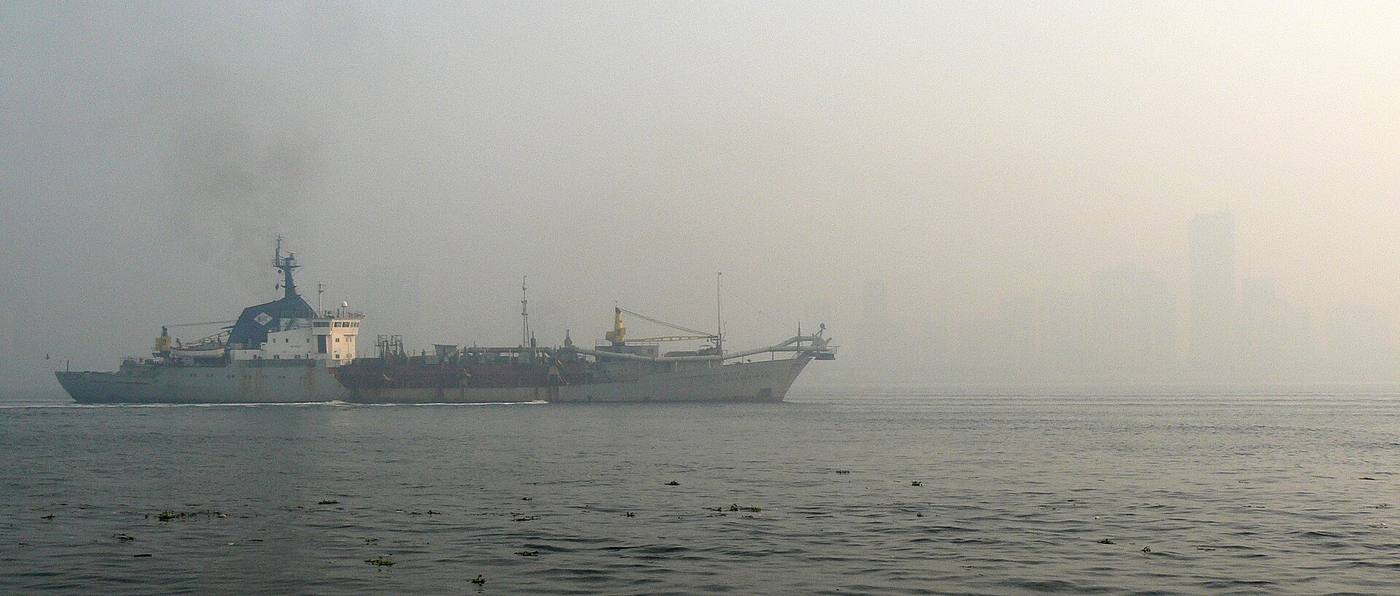
Restricted visibility is the regime in which COLREGS stops being about right-of-way and starts being about caution. Rule 19 — conduct of vessels in restricted visibility — changes the operating assumptions: every vessel is effectively a give-way vessel; 'safe speed' drops; engines must be ready for immediate manoeuvre; and the ambiguity of sound-only bearing detection is explicitly addressed.
This is a different decision problem from the one most AI avoidance work addresses. It's also barely addressed at all.
Key findings
- Rule 19 transforms the manoeuvre logic — the open-water crossing/head-on/overtaking rules give way to universal caution obligations. Established
- Published AI avoidance work almost never evaluates Rule 19 behaviour; the standard test is good-visibility geometry. Established
- 'Safe speed' and 'ready for immediate manoeuvre' are deliberately vague — human-judgement concepts that resist clean reward encoding. Maritime-GPT analysis
- Restricted visibility multiplies sensor uncertainty — the detection gaps compound the decision problem rather than adding to it. Research demonstration
- The honest near-term role is heightening alerts and recommending caution-speed envelopes — decision support, not decision-making. Maritime-GPT analysis
The rules change, not just the sensors
Most AI collision-avoidance work treats COLREGS as a lookup: identify the encounter type (head-on, crossing, overtaking), apply the manoeuvre rule. Rule 19 replaces that lookup with a different structure — no stand-on/give-way distinction in fog; a universal obligation to reduce to safe speed and be ready to manoeuvre immediately; and explicit guidance on the ambiguity of hearing-only contact. A model trained on the crossing rules is answering the wrong question. Established
Why 'safe speed' resists encoding
Rule 19 deliberately leaves 'safe speed' undefined — it depends on visibility range, traffic density, the ship's stopping distance, the radar's performance, and background interference. That is not a number; it is a judgement that incorporates the whole situation. Encoding it as a reward term produces either an arbitrary constant (unsafe in the wrong conditions) or a learned heuristic that has never been validated against the casework that defines 'safe' in law. Maritime-GPT analysis
The compounding problem
In restricted visibility the perception problem and the decision problem multiply rather than add: the sensors degrade exactly as the rules tighten. A radar contact at the edge of clutter becomes a decision input at the same moment the obligation to manoeuvre 'immediately' applies. The fusion systems that handle sensor disagreement (see our multimodal piece) become the load-bearing layer — and they are precisely the systems least evaluated under fog conditions. Maritime-GPT analysis
What we know
- Rule 19 replaces right-of-way logic with universal caution in restricted visibility.
- The AI avoidance literature evaluates good-visibility encounters almost exclusively.
- The vagueness of 'safe speed' is a feature of the rule, not an omission.
What we don't
- A published model that demonstrably encodes Rule 19's caution obligations.
- How to validate 'safe speed' decisions against the casework that defines them.
- Whether RL reward shaping can capture 'ready for immediate manoeuvre'.
Being tested
- Restricted-visibility simulation environments with radar-primary perception.
- Caution-aware policy shaping — speed as a function of uncertainty.
- Uncertainty-aware decision support that flags when to slow.
Maritime-GPT analysis
Fog is where the COLREGS-compliance narrative gets honest. The rules that bend are the ones that were never meant to be rigid — and the models that claim compliance have never been tested in the regime where the rules are vaguest and the sensors weakest. Decision support that flags 'this is a Rule 19 regime, the margins are uncertain' is a real contribution; an avoidance model that scores well on clear-water geometry is not. Maritime-GPT analysis
This is a research feature, not operational guidance. Simulation results are reported as simulation; demonstrations are not deployments; company claims are attributed as such. Verify safety-critical decisions against official nautical publications and flag-state requirements.
Sources & evidence
The caution obligations the decision problem must encode.
Documents the visibility conditions under which models are (and aren't) tested.
The perception side of the same restricted-visibility problem.
The RL approaches whose test regime is the one Rule 19 isn't.