
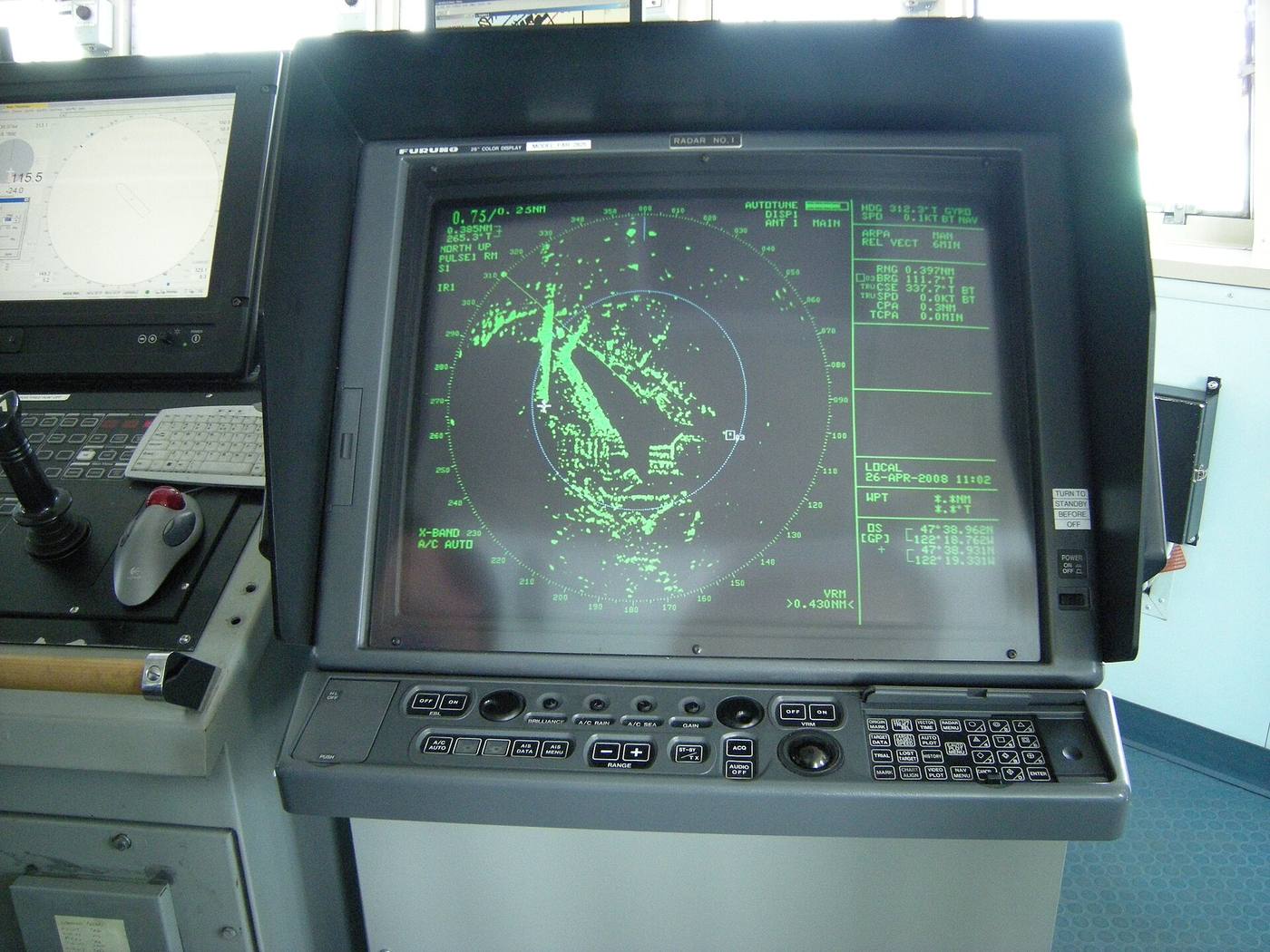
Collision avoidance in the literature is often a clean problem: the tracks are exact, the intentions known, the sensor perfect. The real encounter is none of those — the radar's track has error bars, the other vessel's intentions are unknown, the AIS position is stale or spoofed, and the decision must be made anyway, on incomplete information, before the geometry forecloses the option.
Collision avoidance under uncertainty is the honest version of the problem — and it's where the AI's value is most tested, because the decision's quality is bounded by what the sensors actually deliver.
Key findings
- The uncertainty is structural — sensor noise, track error, unknown intent, and stale data are inherent, not fixable. Established
- The honest decision is probabilistic — the AI should reason over the uncertainty, not pretend it's absent. Established
- Partially-observable RL (POMDP framing) is the research answer — decisions under acknowledged incomplete state. Research demonstration
- The margin must absorb uncertainty — the safety buffer scales with how wrong the input might be. Maritime-GPT analysis
- The 'not knowing' must be visible — the system's output should surface its uncertainty, not hide it. Established
The uncertainty is the normal case
Every collision-avoidance decision happens under uncertainty — the other vessel's position is a radar track with error bars, her intentions are unknown, her next manoeuvre is unmodelled, and your own ship's response has lag and drift. The clean-simulation version assumes away the uncertainty; the deployed version must live in it. An AI that treats the inputs as facts is deciding on fiction; one that treats them as distributions is deciding on the actual situation. Established
The probabilistic answer
The research direction is to make the uncertainty explicit — the partially-observable Markov decision process (POMDP) framing treats the track as a distribution, the intention as a hypothesis, and the decision as optimal under acknowledged ignorance. The AI doesn't choose 'the right manoeuvre'; it chooses the manoeuvre that's most robust across the plausible situations the uncertain input might represent. The decision's output carries its own uncertainty — 'avoid starboard with 80% confidence' — which the supervisor needs to see. Research demonstration
The margin is the buffer
The practical engineering is that the safety margin must absorb the input uncertainty — the CPA buffer, the manoeuvre-timing slack, the closest-approach tolerance all scale with how wrong the sensor might be. A system that sizes its margins to the stated position is one degraded input away from a collision; one that sizes them to the uncertainty — 'the track could be off by this much' — is one that survives the sensor's imperfection. Maritime-GPT analysis
The output must show the doubt
The trust-critical feature is the uncertainty display — the system that presents its decision alongside its confidence lets the supervisor see when the AI is guessing. 'Recommend starboard turn — confidence high, input reliable' versus 'recommend turn — target track degraded, confidence low' are different outputs, and the second is the honest one. A collision system that hides its uncertainty produces decisions that look the same whether they're well-founded or not — which is exactly the failure mode the supervisor exists to catch. Established
What we know
- Collision decisions under uncertainty are the real problem — the clean version is a simplification.
- Probabilistic reasoning over the uncertain state is the honest approach.
- Safety margins must scale with input uncertainty.
What we don't
- Whether POMDP-based policies outperform in live deployments.
- How to certify a decision system whose inputs are distributions.
- The uncertainty-display standard that keeps supervisors calibrated.
Being tested
- POMDP collision-avoidance policies under realistic sensor models.
- Uncertainty-aware margin sizing.
- Confidence-surfacing decision displays for supervisors.
Maritime-GPT analysis
Collision avoidance under uncertainty is the honest version of the problem the clean simulations skip — the sensor's noise, the other's intent, the track's error bars are the actual inputs. The AI's job isn't to be certain; it's to decide well while admitting what it doesn't know — the margin sized to the uncertainty, the confidence displayed with the decision, the supervisor shown the doubt. A system that pretends its inputs are exact is a confident answer to a question it wasn't asked. Maritime-GPT analysis
This is a research feature, not operational guidance. Simulation results are reported as simulation; demonstrations are not deployments; company claims are attributed as such. Verify safety-critical decisions against official nautical publications and flag-state requirements.
Sources & evidence
Recent work on realistic collision-avoidance.
The dynamics side of the honest problem.
The safety verdict this uncertainty analysis informs.