
A 'foundation model' is a single pretrained model that generalises across downstream tasks — the paradigm that produced GPT and the vision transformers. Maritime has produced domain models in slices: OceanGPT for ocean-science language tasks, AIS-LLM and TG-GPT for trajectory prediction, assorted smaller efforts for navigation and port data. A true maritime foundation model — one pretrained across the sea's heterogeneous data to transfer across navigation, logistics, surveillance and engineering — does not yet exist.
Building one is a tractable engineering problem with an unusual bottleneck: the data exists but isn't unified, and the tasks are unusually safety-bounded. This article maps the state of the effort.
Key findings
- Maritime has domain models (OceanGPT for science, AIS-LLM/TG-GPT for trajectories) but no unified multimodal foundation model. Established
- The data modalities are unusually heterogeneous: AIS tracks, chart/raster data, satellite imagery, weather, text rules, engine telemetry — the fusion problem is the foundation problem. Maritime-GPT analysis
- Safety-criticality distinguishes maritime from other domains — the foundation model's failure modes (hallucination, extrapolation) are governed by COLREGS and MASS stakes. Established
- Data access is the binding constraint: AIS and imagery are largely proprietary or licence-restricted; the open corpora are small. Established
- The credible path is a hybrid — pretrained backbones on available modalities plus maritime-specific alignment — not from-scratch training. Proposed
What 'foundation' would mean at sea
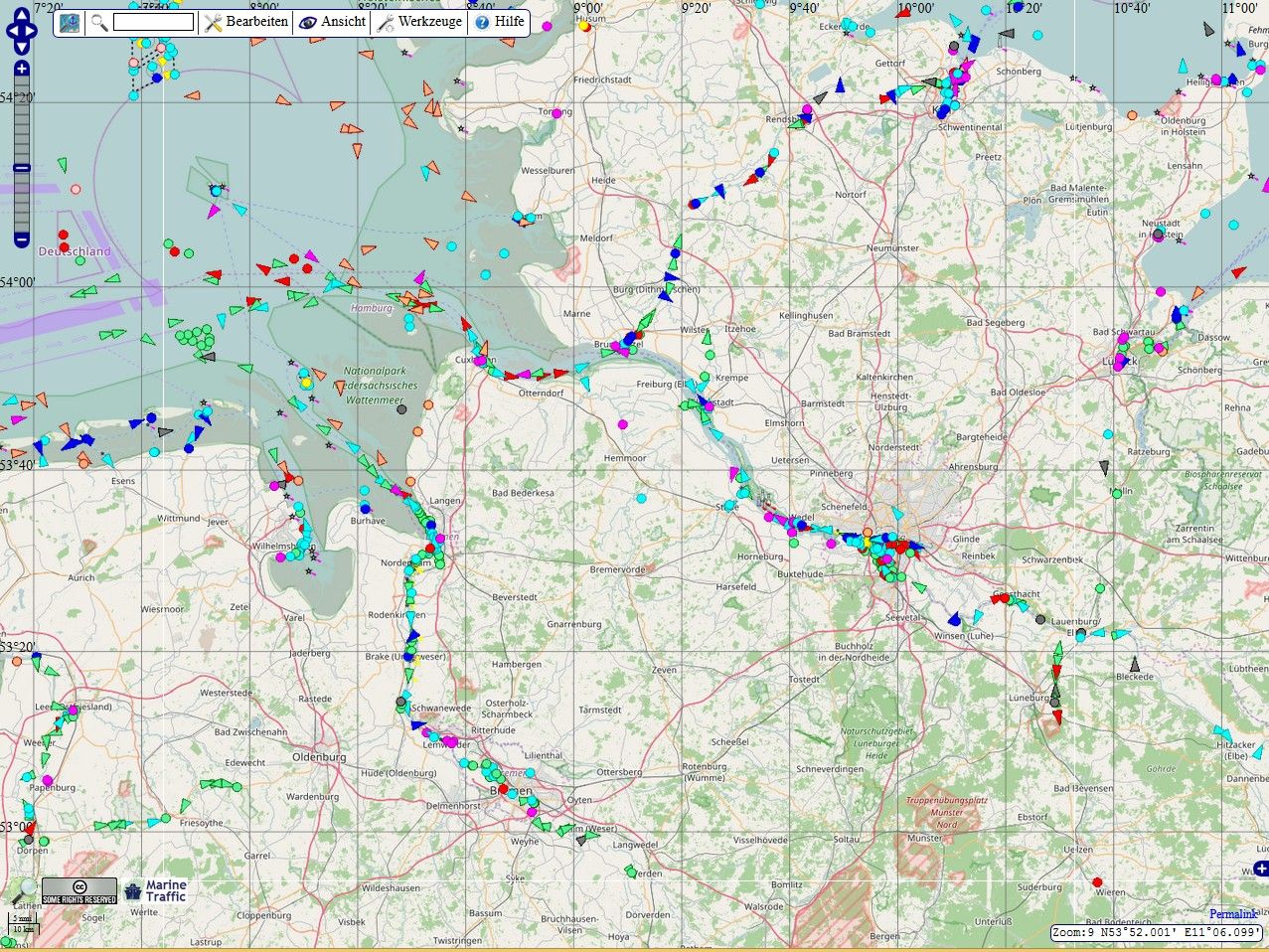
The test of a foundation model is transfer: a model pretrained on the domain's raw data that can be adapted — with little task-specific data — to many downstream uses. For maritime that would mean a model pretrained jointly on AIS trajectory corpora, nautical-chart structure, satellite SAR/optical ocean imagery, weather reanalysis, regulatory text and machinery telemetry — that then adapts to ETA prediction, collision risk, anomaly detection, surveillance, and route reasoning. No published model does that breadth; the current efforts are single-modality or single-task foundations. Maritime-GPT analysis
The modalities that must fuse
| Modality | Exists at scale? | The gap |
|---|---|---|
| AIS trajectories | Yes — commercial + open subsets | Licence-restricted; proprietary feeds |
| Satellite SAR/optical | Yes — Sentinel, commercial | Pretraining for ocean-specific features thin |
| Nautical charts / bathymetry | Partially — ENC is licensed | Raster+vector fusion underused |
| Weather reanalysis (ERA5) | Yes — open | Under-integrated with vessel data |
| Regulatory / text (COLREGS, MASS) | Yes — text corpora | Aligned to rules, not operational data |
| Machinery / engine telemetry | No — proprietary, ship-specific | The missing modality for engineering tasks |
Why a from-scratch maritime model is a bad bet
Foundation-model economics punish from-scratch training: the compute and data scale is prohibitive, and most maritime tasks don't need a novel architecture — they need a good general model aligned to the domain. The credible route is the one the work already shows: take a strong pretrained backbone, add maritime-specific encoders (AIS tokenisation, chart representations, SAR features), align them to the language/reasoning backbone, and fine-tune per task. AIS-LLM's time-series-encoder-plus-LLM pattern is exactly this. Research demonstration
The safety caveat nobody can skip
A maritime foundation model inherits the full failure-mode catalogue of large models — hallucination, silent extrapolation, confident error — in a domain where the stakes are collision and grounding. The architecture that makes a maritime FM usable is the same one that makes the SLM and agentic work safe: the FM is a knowledge and reasoning layer; the safety-critical decisions go through constrained, validated downstream modules. A maritime foundation model is a component, not a system. Maritime-GPT analysis
What we know
- Domain models exist per modality; a unified maritime FM doesn't.
- The fusion problem — AIS+imagery+charts+telemetry+text — is the actual research problem.
- Hybrid alignment of pretrained backbones is the demonstrated path.
What we don't
- A published maritime foundation model evaluated across the full task range.
- How to license and unify the proprietary AIS and imagery corpora at scale.
- Whether a maritime FM outperforms per-task specialist models on the safety-critical tasks.
Being tested
- Multimodal AIS+SAR+chart pretraining.
- Trajectory-language alignment (AIS-LLM pattern) extended to other tasks.
- Evaluation suites that measure transfer, not single-task accuracy.
Maritime-GPT analysis
The maritime foundation model is real as a research direction, not as a product. The building blocks — trajectory encoders, ocean-domain LLMs, satellite foundation models — exist and are being connected. What doesn't exist is the unified model, and what makes it hard isn't compute, it's the licence walls around the data and the safety constraints on the outputs. Expect the maritime FM to emerge as an aligned hybrid of existing backbones, not a bespoke trillion-parameter ship-model. Maritime-GPT analysis
This is a research feature, not operational guidance. Simulation results are reported as simulation; demonstrations are not deployments; company claims are attributed as such. Verify safety-critical decisions against official nautical publications and flag-state requirements.
Sources & evidence
The ocean-domain LLM — the science side of the maritime-FM problem.
The trajectory-foundation pattern — time-series encoder aligned to an LLM.
A lightweight maritime GPT for trajectory — the specialist-model pole of the comparison.
The compute/budget argument for aligned-hybrid over from-scratch.